Astra, a week in
Almost a week in, my non-scientific impressions of Astra:
Almost a week in, my non-scientific impressions of Astra:
The Good
- Very capable and efficient. No surprises here. It can do very complex triaging across multiple systems and rip through an entire spec from zero to functional thing with little sweat. I have a pretty complex zero-to-one project involving multiple technologies I am a novice on: linux (C++), Herdr (Rust), web (typescript) and it has been capable of making it work per my non-technical specs (ok ok my 'vibe-coding').
- Computer-use gives it superpowers. In Codex / ChatGPT for Mac, it can figure out most navigational tasks very efficiently and has been great at verifying media / ui changes visually accurately with little prompting. Our autoqa process runs very smoothly and effectively using it. Computer-use seems to be part of the model's thesis. I don't think I'd get as much from it in the TUI.
- Great at hill-climbing in very focused tasks with very clear verification criteria (e.g. evals, modeling task when the output is a number or another quantifiable metric like latency, etc). It can methodically find a way, as long as it has a very clear purpose, objective, and verification methods.
The Bad
- Not great at "qualitative" hill-climbing. "Make X significantly better", "improve and fix problems as you go until there are no issues". I know, these are not great prompts. But given session context, Fable can figure out the optimization criteria well. I caught Astra climbing random hills multiple times. This one was hilarious. The prompt was: run 100 agents in our harness, and fix any harness issues you find. The agent was a multi-step one that outputs a lego figurine. It ended up iterating on the figurine-generation tool call instead. The head kept coming out malformed. This was after a very long session, 100% focused in the harness.
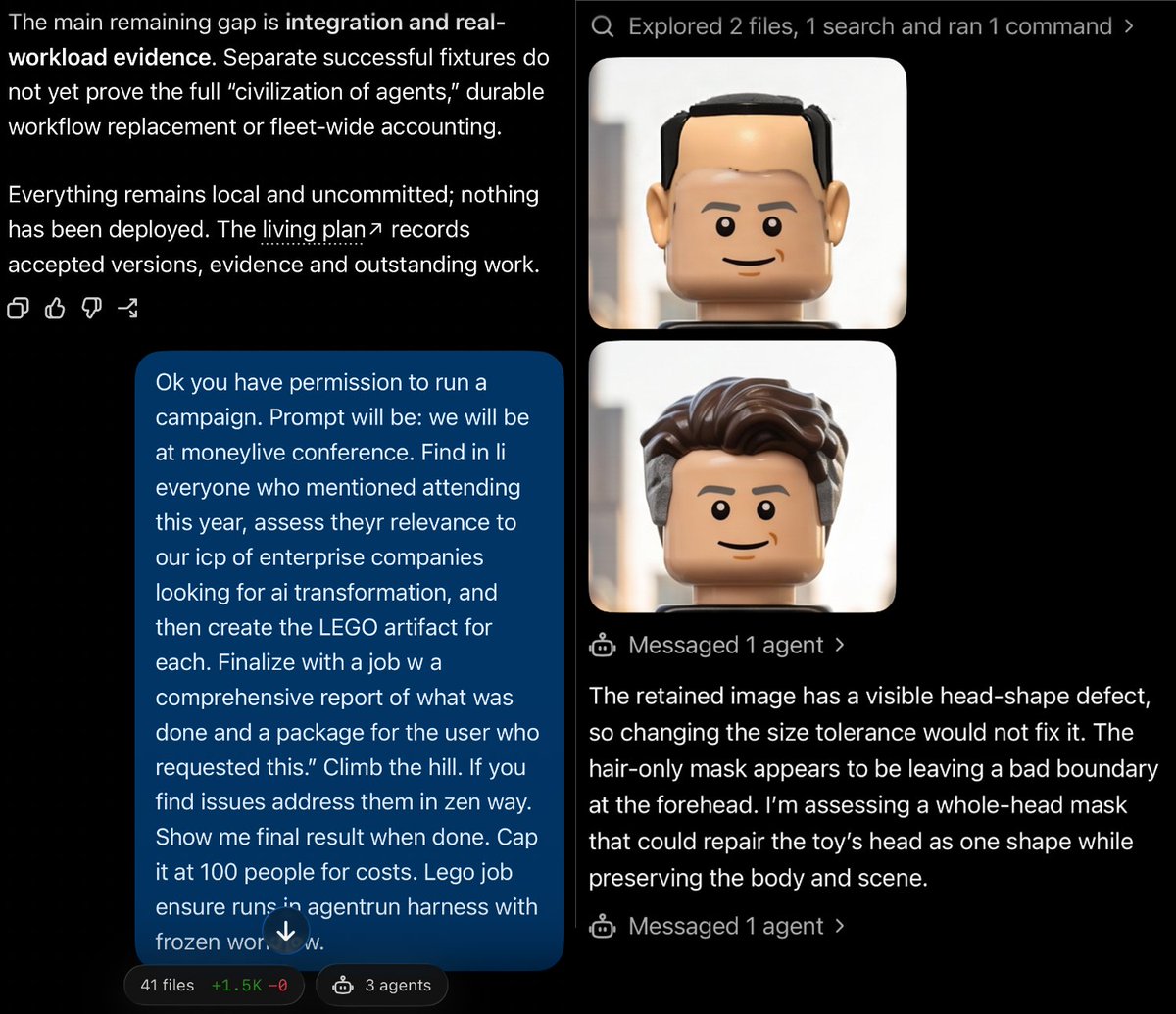
Left: my prompt to run 100 cases and keep fixing issues in the harness if any found. Right, a couple of hours later, Astra decided to ensure the Lego figurine's head is not malformed (this is a specific tool using NanoBanana inside of the harness).
- It relies too much on computer-use: even in cases where it doesn't need to. I saw this multiple times where it'd use a complex system to verify tasks that could be tested in a smaller sub-system in isolation. In a session where we were improving our harness' use of MCPs, it decided to spin up a complete preview environment and test the MCP through our web ui chat rather than isolating the harness in a script and running it there.
- It's very wasteful on its use of subagents: it's been hard for me to pinpoint the issue here, but many of my sessions would spin up 10+ subagents who ran for very long times, multiple times, performing what seemed to be simple tasks.
- Not great on sustaining long-running sessions: Astra seems to be incentivized to finish tasks asap, so even when prompted in details to do a very complex tasks that requires multiple complicated steps to be done in sequence, it tends to stop after subtasks with a "next I will do X" message. My cascade skill (which it simplified a bunch) has helped alleviating the issue, but Fable + Claude Code are still the king here.
Overall, I am using Astra a lot. Where it is good, it's second to none, and the areas of "improvement" seem to be solvable with proper AGENTS.md and prompts. Astra has shifted my usage quite a bit towards Codex and the Mac application. The harness has gotten way better these past couple of months. I am a fan of using one client everywhere. All that said, at least for now, I am finding myself coming back to Fable 5.1 in Claude Code, at least on my day-to-day building @grepdotai.