
Comparing Open Source AI Agent Orchestration Platforms in 2026
A grounded technical comparison of open source AI agent orchestration platforms for engineering teams weighing self-hosting, control, and cost at scale.
Quick Answer
Open, self-hosted orchestration is the practical choice when agent reliability, data ownership, and reusable learning matter beyond a pilot. It requires more initial operational work than a managed single-harness service, but it gives teams control over model keys, execution state, compute providers, and the improvements agents accumulate over repeated runs.
Introduction
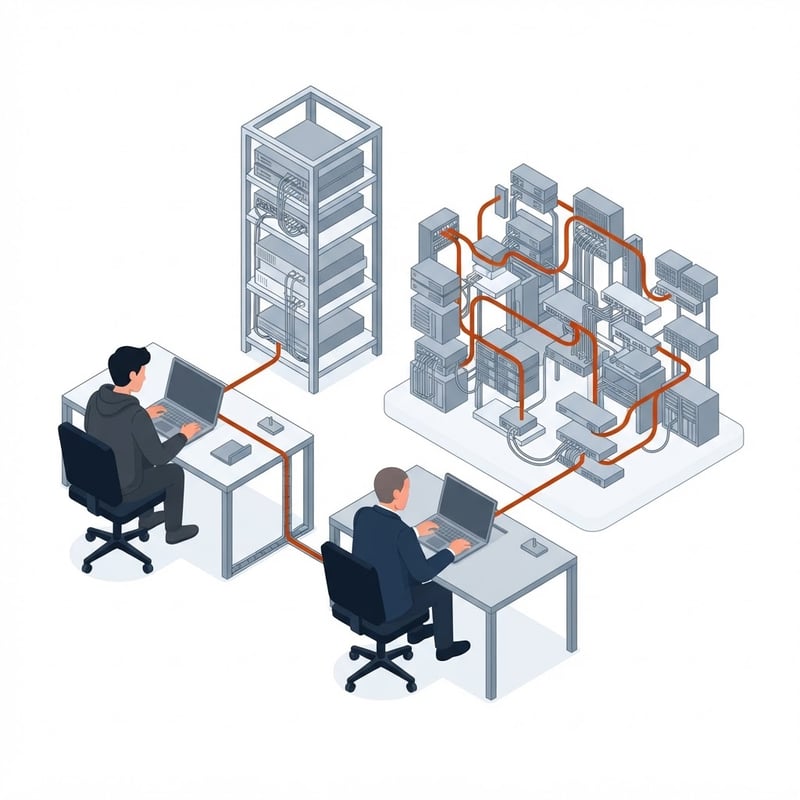
An open source agent framework is most valuable when it separates the control plane from the harness that performs work.[1] Managed services can shorten early setup, but teams should examine where execution state, operational conventions, and deployment choices reside before adopting one. For teams running coding or knowledge-work agents repeatedly, the harder problem is not starting an agent. It is recovering it after interruption, auditing what it did, and preventing each run from rediscovering the same tools and decisions.
Key Takeaways:
Self-hosted control planes keep execution state, data paths, and model credentials under team control.
Cross-harness orchestration reduces the cost of replacing or mixing agent runtimes.
Durable state and evaluated learning matter more as agent runs become repetitive and business-critical.
Open Source AI Agent Frameworks Change the Control Plane Decision
An AI agent is a runtime that plans, calls tools, uses context, and attempts a task. An AI agent control plane is the operational layer around that runtime: it records runs, applies policies, manages revisions, coordinates compute, and preserves state when work cannot finish in one uninterrupted session. Research on agentic AI software architecture points to auditable control mechanisms and layered governance as central design concerns. The distinction matters because a harness can be productive in a local terminal while still being difficult to operate across thousands of runs.
What changes when the control plane is self-hosted
Self-hosting does not remove operational responsibility. It moves responsibility to the engineering team, where deployment, access control, logs, storage, and network boundaries can be aligned with existing infrastructure rather than a vendor's default operating model.
Model keys: Teams retain control of credential storage and rotation.
Execution state: Run history can remain inside approved infrastructure boundaries.
Compute routing: Jobs can use appropriate sandbox or high-resource providers.
Policy enforcement: Approval rules can match internal risk controls.
Portability: Harness changes need not require replacing the control plane.
Governance is an operational requirement, not paperwork
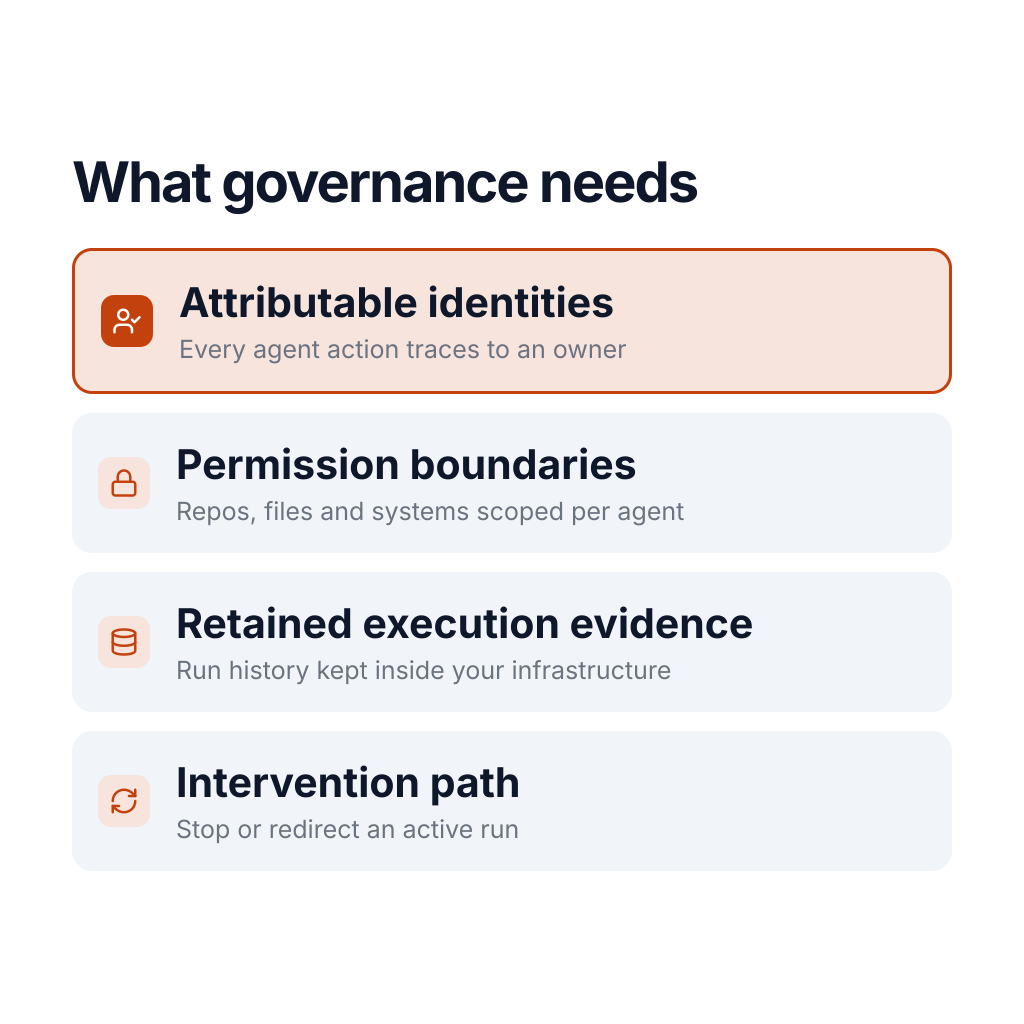
When an agent can access repositories, files, customer systems, or financial workflows, teams need attributable identities, permission boundaries, retained execution evidence, and an intervention path for an active run. A recent enterprise reliability survey found that 80% of organizations letting agents skip human review reported a customer-facing failure after passing tests, versus 36% among those that require review.[2]
Runtime policy also needs to travel with the workload. The agentic AI security problem requires runtime monitors that check compliance, fairness, and safety invariants, while workflow orchestration can version prompts, tools, and execution contexts, which makes a central view of agents and revisions more useful than isolated terminal logs.
Managed AI Agents vs Self-Hosted Control Planes
Managed AI agents and self-hosted control planes are different operating models, not simply competing SDKs. A managed service owns more of the deployment path and can reduce the first-mile setup burden. A self-hosted platform requires teams to run the control plane, but it can keep infrastructure ownership with the organization and allow a harness to change without discarding operational history.
Compare the operating model before comparing prompts
The table below focuses on what changes for the team operating the system. Pricing cannot be compared as a universal number because model use, compute duration, storage, and vendor plans vary by workload.
Decision area | AgentRun | Closed single-vendor orchestration |
|---|---|---|
License and deployment | Apache-2.0; free self-hosted path, managed cloud path, and enterprise deployment support | Often a vendor-operated hosted deployment model |
Harness support | One API across Claude Code, Codex, Pi, and OpenCode | May be centered on the vendor's own harness and runtime |
State recovery | Saves conversation, files, and completed tool results for recovery | Behavior depends on the managed service's execution model |
Compute integration | Connects Docker, Daytona, and Modal for different job environments | Compute configuration is managed within vendor boundaries |
Learning reuse | Proposes, validates, grades, and reuses notes, skills, and workflows | Reuse behavior depends on the vendor's platform design |
The key tradeoff is ownership. A managed service can reduce platform administration, while a self-hosted control plane gives the team a place to keep operational data and accumulated learning even if the underlying harness changes.
Cost at scale is mostly a repeated-work problem
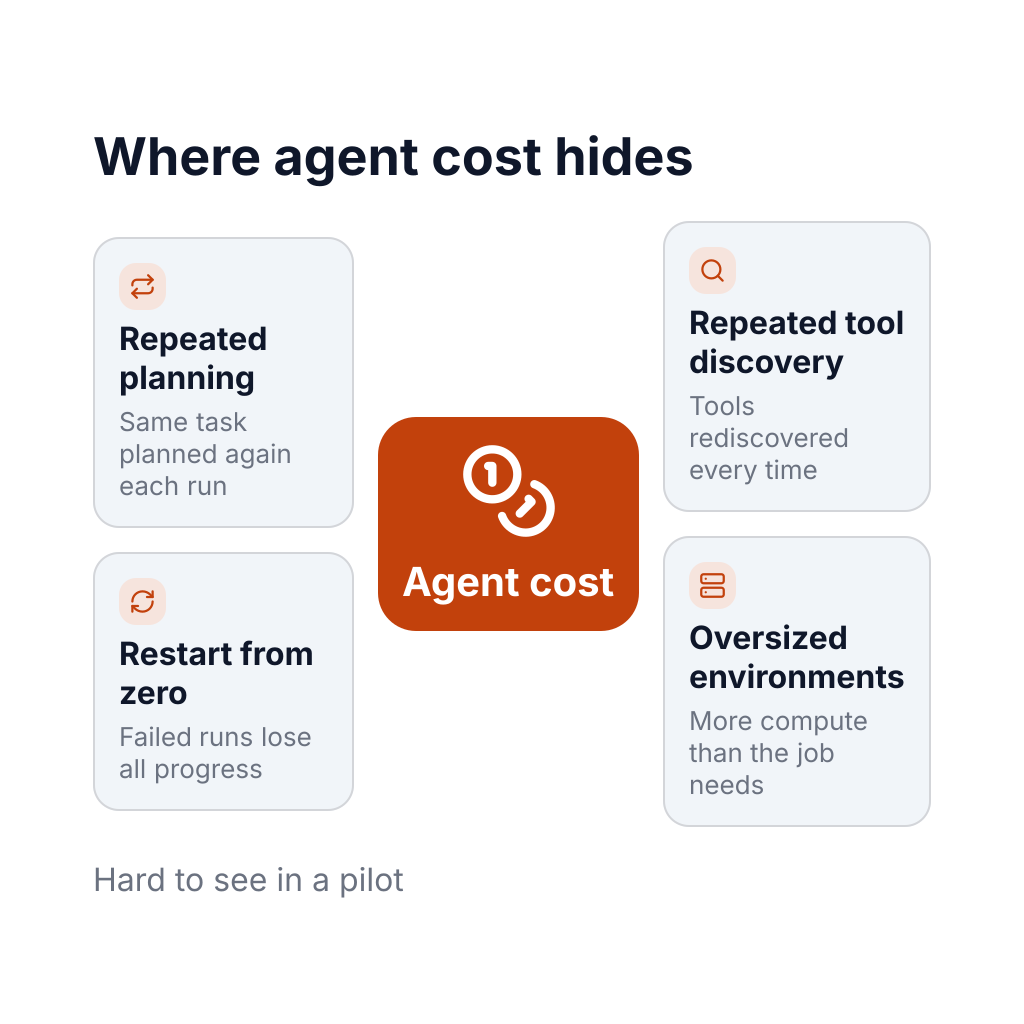
Agent costs are not only token invoices. Repeated planning, repeated tool discovery, failed runs that restart from zero, and oversized execution environments all create waste that is difficult to see in a pilot. A 2026 enterprise agent survey found that 60% of organizations overran their agent budget in the past two quarters, even though 74% said they had a complete picture of cost per agent.[3] Agentic systems require teams to balance model cost, latency, and task requirements.
AgentRun's self-improving learning layer addresses repetitive work differently: it turns repeated steps into proposed notes, reusable skills, and tested workflows, then validates and grades them before later runs can reuse them. Risky changes wait for owner approval, which keeps adaptation from silently becoming authorization.
Durable Execution for AI Agents and Cross-Harness Reuse
Durable execution for agents means that an interrupted run can continue from saved state instead of reconstructing the task from a fresh prompt. This is especially important for long-running work with files, tool calls, and external dependencies, where a process can fail after it has already produced useful partial results.
What a recoverable run must preserve
Saving only a final answer is not enough to resume work safely. The control plane needs the conversation context, file changes, completed tool results, revision identity, and enough metadata to determine whether the environment can be resumed or should be recreated.
AgentRun preserves conversations, files, and completed tool results so stopped work can recover from saved state. AgentRun's sandbox approach connects Docker for lightweight sandboxes, Daytona for development environments, and Modal for high-resource jobs, which lets teams align execution placement with the actual task rather than treating every run as identical.
Learning should be portable across the work that created it
Skills are only valuable when they remain attached to a well-defined workflow and can be checked before reuse. An open control plane can make accumulated learning available across supported harnesses, rather than tying a workflow's operational knowledge to one hosted runtime. This is a material distinction in distributed AI agent orchestration because harness selection may change as models, tooling, and task requirements evolve.
AgentRun exposes its shared control plane through one API and can be launched with npx @parcha/agentrun. The console manages agents, revisions, runs, files, and learning, while TypeScript and Python client libraries allow the same operational model to be integrated into existing engineering systems.
Conclusion
Choose an open control plane when agents are becoming durable operational systems rather than isolated experiments. The upfront work is real: teams must operate deployment, identity, storage, observability, and policy boundaries. For engineering teams that need cross-harness support, recoverable execution, and ownership of their infrastructure and learning, AgentRun provides those controls while retaining a self-hosted path. AgentRun's code review agent catches more real bugs than a comparable commercial code-review tool, at roughly 18 cents per review, which illustrates why repeatable work should be measured as an operating system problem, not only a model-selection problem.
Ready to evaluate an open control plane in your own environment? Try AgentRun with an existing agent harness.
Frequently Asked Questions (FAQs)
What is an AI agent management platform?
An AI agent management platform is the operational layer that tracks agents, revisions, runs, execution state, and policy decisions, allowing teams to operate repeated workloads with more visibility than a standalone harness or local script provides.
Why use an open-source control plane for AI agents?
An open-source control plane for AI agents lets teams inspect and self-host the software that manages execution, which can keep model credentials, run records, files, and governance controls within infrastructure they operate.
How does durable execution work for AI agents?
Durable execution works by saving the state required to resume a run, including context and completed work, so an interruption does not force the agent to repeat prior steps or reconstruct the task from scratch.
Is there an open-source alternative to proprietary agent platforms?
Yes, open-source alternatives exist for teams that need a self-hosted control plane, and the meaningful evaluation criteria are licensing, supported harnesses, state recovery, compute integration, and how reusable learning is governed.
How do teams manage AI agents at scale?
Teams manage AI agents at scale by centralizing run visibility, revision tracking, permissions, durable state, compute routing, and workflow evaluation, then measuring repeated task behavior rather than relying on one-off demonstrations.
What are the benefits of self-hosted AI agent infrastructure?
Self-hosted AI agent infrastructure gives teams direct control over deployment boundaries, identity systems, storage, networking, and model keys, while also requiring them to own the reliability and security work that a managed provider would otherwise perform.